
Leonora Carrington Self-Portrait (The White Horse Inn)

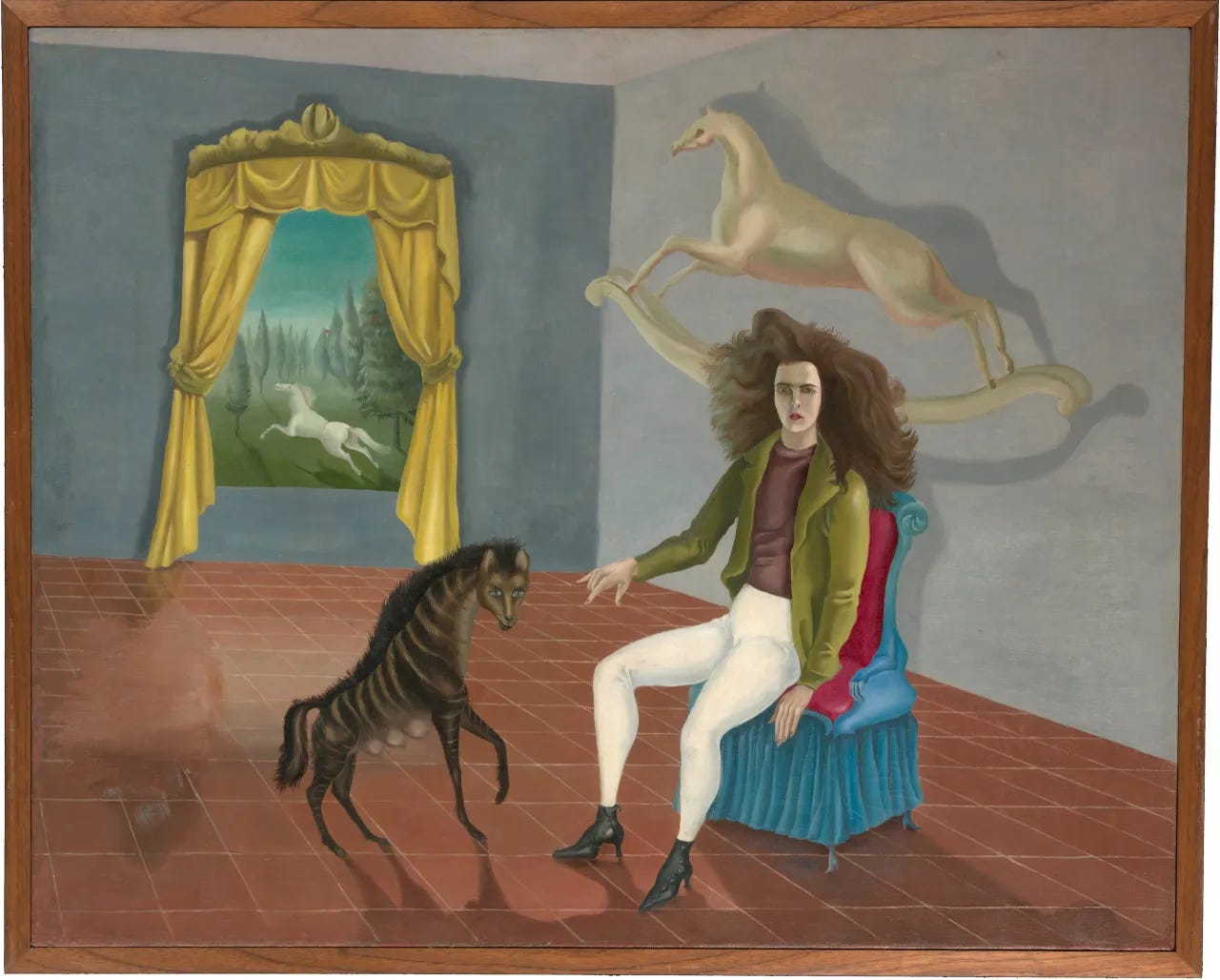
The Surrealist painter Leonora Carrington used a traumatic moment in her life and created “Self-Portrait (The White Horse Inn).” She lived from 1917 until 2011. She was born in England to an Anglo-Irish family. She felt significantly repressed so she left home in 1937. Carrington painted and worked in a lot of different locations. She lived in London, England, where her mom sent her to study art in 1936. This is when she falls in love with the Surrealist art movement. She then becomes a muse for the male Surrealist artist. She was considered an attractive witch. Her mystic feminine energy attracts a lot of people. Including Max Ernst, notably 26 years older than she. She and Ernst eventually start a relationship. She is renamed by Ernst, Bride of the Wind, and they moved to France. “Surrealist art, showed Carrington how to discern the folly of the humans she knew. It also invited her to cavort with nonhuman creatures, drawing on their beauty and suffering to make tame ideas about character and plot more porous, elastic, and gloriously unhinged” (Emre). When Nazi’s came she was creating, “Self-Portrait (The White Horse Inn).” This painting was created in 1938, oil on canvas, 25 5/8 x 32 inches. In this portrait she was experiencing a mental breakdown when Max Ernst was interned in prison in France. This painting is filled with Celtic mythology and childhood memories. In this painting she is the protagonist with wild hair and a pale, catatonic stare towards the viewer. She befriends a Hyena with engorged teats and a rocking horse with magical powers. She is reaching for the magical hyena. Her experiences with Celtic mythology and everything magical helped her to create this art piece that brought out personal things and her way of coping through art.
There is so much more that I wanted to talk about, but I will do more drafting on the treatment of women in this particular art movement! Also, Max Ernst is for the STREETS I tell you, and he needed to be in the jailhouse. But he dead so I will let it go.
Thank you for reading,
Monee B.
Works Cited:
Emre, Merve. “How Leonora Carrington Feminized Surrealism.” The New Yorker, 21 Dec. 2020, www.newyorker.com/magazine/2020/12/28/how-leonora-carrington-feminized-surrealism.
Mansfield, Elizabeth, C. and H. H. Arnason. History of Modern Art. Available from: VitalSource Bookshelf, (7th Edition). Pearson Education (US), 2013.